Best Books on the Law of Attraction (and What Comes After Them)
The 5 law of attraction classics still worth reading, 3 books that reach for the science, and the one book that picks up what the classics leave unresolved.

Best Books on the Law of Attraction (and What Comes After Them)
Most people who arrive at the law of attraction arrive there tired. Something has not worked. A relationship, a career, a bank account, a body. The classics of the genre offered a frame that made the problem tractable: your outer reality mirrors your inner state, and if you can change the inner state, the outer follows. That frame is not wrong. It is incomplete.
The reading path below respects the classics. Some of them still hold up decades later, not because their metaphysics are airtight, but because they name something psychology takes seriously: your inner state shapes how you see, choose and act, and so shapes much of your experience. Where they stop short is the actual biology of how that happens, and what to do when the belief work alone does not move the needle.
Read this list in order. The classics first. The science second. Then the honest question of what comes after.
The 5 Classics Every Manifestation Reader Should Know
1. The Secret by Rhonda Byrne (2006)
What it got right: it made a private idea public. Before The Secret, the notion that thought influences experience was scattered across new-thought pamphlets, Napoleon Hill, and a handful of quiet spiritual traditions. Byrne collapsed it into one accessible book and one film, and the cultural conversation moved.
Where it stops short: The Secret’s mechanism is essentially “think it, feel it, receive it.” That formulation ignores the nervous system entirely. Byrne assumes the reader can freely choose their thoughts and feelings, which is exactly what a stressed, overloaded nervous system finds hard. Many readers followed the instructions and got frustrated when nothing changed. The instructions were not wrong. They were operating at the wrong layer.
Read it: for the historical anchor and the vocabulary. Then keep reading.
2. Ask and It Is Given by Esther and Jerry Hicks (2004)
What it got right: the emotional scale. Hicks introduced what is essentially a felt-sense ladder, from powerlessness at the bottom to joy at the top, and taught readers that their point of attraction is set by where they sit on the ladder in any given moment. This is closer to lived experience than pure thought-based manifestation. Emotions involve the body as well as the mind, and in the Frequara model your emotional state is a large part of what the books call your broadcast.
Where it stops short: the “just feel better” instruction is deceptively hard. Moving up the emotional scale is not a matter of choosing better thoughts. It usually takes practice in noticing what your body is doing, settling it, and staying with steadier feelings when the old ones pull you back. Hicks names the map. The map does not tell you how to build the vehicle.
Read it: for the emotional-scale framework. Ignore the channelling frame if that is a barrier for you. The observation still holds.
3. You Are a Badass at Making Money by Jen Sincero (2017)
What it got right: humour is a legitimate change agent. Sincero’s contribution is tonal. Her books gave permission to work with money and manifestation without spiritual-bypass earnestness. That matters, because humour can take the tension out of a subject that feels heavy. Many readers find it easier to stay with a book that is genuinely funny than with one that is reverent.
Where it stops short: Sincero’s advice on the mechanics of belief change is the standard “change your energy” framing, without the somatic infrastructure to make it actionable for people with unresolved money trauma. If the tone lands for you, it can be a useful entry point. Just do not mistake tonal accessibility for methodological completeness.
Read it: for permission. Then look for the mechanism elsewhere.
4. The Science of Getting Rich by Wallace Wattles (1910)
What it got right: the original text. Byrne cites Wattles as the source that started her chain of inquiry. Wattles proposed that a “certain way” of thinking and acting produces wealth, and he laid out the elements with a straightforwardness that later authors turned into style. The core idea, that a consistent inner orientation shapes what you do and so, over time, what you get, still reads as sound.
Where it stops short: Wattles was writing before neuroscience existed. His model of the “thinking substance” is metaphysical. Read it as a historical document and a beautifully compact articulation of the pattern, not as a physiological guide.
Read it: as the origin. It is short, free in the public domain, and worth an afternoon.
5. Think and Grow Rich by Napoleon Hill (1937)
What it got right: Hill traced a chain that most later books skip. Desire produces emotion produces belief produces action produces outcome. Each link is a reasonable description of how motivation becomes behaviour, though real life is messier than a straight line. Modern behavioural science and habit research cover similar ground in their own terms.
Where it stops short: Hill’s proof structure is anecdotal, and some of his interpretations of his interviews with Andrew Carnegie and others are, generously, embroidered. Read the chain, not the biographies.
Read it: for the sequence. Then interrogate whether your own chain is broken at desire, emotion, belief, or action.
The 3 Books That Bridge Law of Attraction to Science
The classics name the pattern. These three reach for the mechanism.
6. Breaking the Habit of Being Yourself by Joe Dispenza (2012)
Dispenza’s contribution is bringing neuroplasticity into the manifestation conversation. He argues that repeated thought and emotion shape experience partly because they shape neural wiring, and the brain’s ability to change with repetition is well established. Rehearse a state often enough and it can start to feel like a trait. Rehearse a trait often enough and it can become part of your identity. His further claim, that the world you meet then begins to match it, goes beyond what the research shows.
His meditations get more elaborate than most readers need. The core insight is what matters: habits of attention and emotion can be trained, and in the Frequara model that training is where manifestation work starts.
7. The Biology of Belief by Bruce Lipton (2005)
Lipton is a cell biologist by training, and his book made the case that cellular behaviour is influenced by the biochemical environment the cell sits in, which is itself influenced by perception. That gene activity responds to the environment is mainstream biology. The stronger claim that “genes are not destiny, environment is”, with belief and perception steering our genes, goes well beyond what epigenetics research shows. Lipton was early to popularise the idea, and the book is still a readable bridge between cellular biology and inner-state work.
Many of his interpretations stretch further than the peer-reviewed literature supports. Read him for the framework, not as a substitute for primary sources.
8. E-Squared by Pam Grout (2013)
Grout’s book is nine experiments. That is the format. Each experiment gives you a hypothesis, a protocol, a time frame, and a place to record what happens. It is empirical in structure, which is exactly what most manifestation books are not. Whether the results generalise is a separate question. As a training in treating your own life as a testable environment, it is uniquely useful.
Read it: for the experimental posture. That posture is closer to the Quantum Frequara stance than any of the classics on this list.
Where All These Books Stop Short
Put the eight books above side by side and a pattern emerges. All of them address one or two of the layers involved in creating a coherent broadcast. None of them address the full stack.
In the Quantum Frequara books, the full stack has four layers, from quietest to loudest: words, thought, emotion and identity, with the state of your body running underneath all of them. When the layers conflict, the louder one tends to win. This is the Signal Hierarchy, a model for thinking about change, not a finding from physics.
The classics work mostly at the level of thought and words and, sometimes, emotion. That may be why some readers, those who already feel fairly settled and whose sense of who they are already fits what they want, find them helpful straight away. Those readers write the glowing reviews. Everyone else tries the same instructions and wonders what is wrong with them.
The honest answer is nothing is wrong with them. The instructions were operating one or two layers above the layer where the block actually lives. Often the problem is not a failure of belief. It is that a new state is hard to hold for long enough to become a habit, especially when the old one is familiar. That is something you can practise. The classics did not have the vocabulary.
The 12 Laws of Creation (What Comes After)
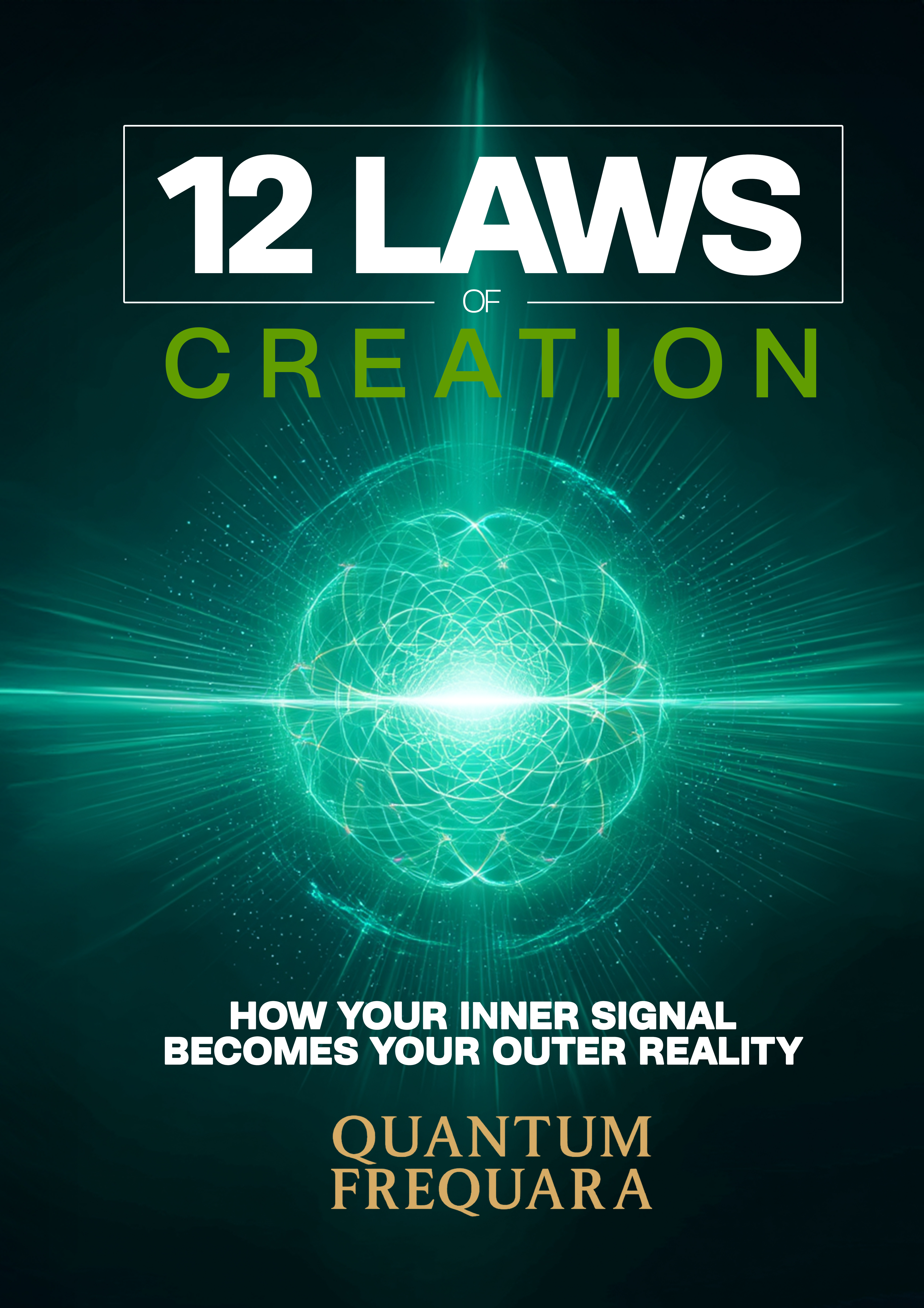
The 12 Laws of Creation is Quantum Frequara’s answer to the question the classics leave open. It is a full-stack book. It treats manifestation as something that runs through your body, habits and choices, not only a metaphysical idea, and it gives the reader a practical vocabulary to work each layer.
Law of Signal names what you are actually broadcasting, moment by moment. Law of Coherence explains why mixed internal signals produce mixed external results. Law of Emotion treats felt states as signals to read, using frequency as a metaphor, rather than moods to be managed. Law of Belief maps identity to nervous system default state. Law of Resonance explores why a steady, consistent signal tends to draw matching responses from the people and situations around you.
The Frequara Correction, the four-step practice at the centre of the framework, is how the laws become a daily practice. Recognise: notice and name the state you are in. Reset: let the body shift first with one calming action, such as a slow exhale. Realign: choose one true, believable step beyond where you are. Radiate: take one action that matches the signal you are choosing.
This is not a replacement for the classics. It is one answer to what the classics were pointing at, with a daily practice attached. If The Secret was the entry point, The 12 Laws of Creation is the operating manual.
Reading Order by Reader Type
The classic reader. Start with The Secret for the frame, then Ask and It Is Given for the emotional-scale mechanism, then The 12 Laws of Creation for the full-stack operational practice. Add Wattles and Hill if you enjoy the historical texts.
The science reader. Start with The Biology of Belief for the cellular layer, then Breaking the Habit of Being Yourself for the neural layer, then The 12 Laws of Creation for the nervous system and identity layers. Follow up with E-Squared for the experimental posture.
The reader who has tried everything and is ready for what comes next. Skip the recap. Go straight to The 12 Laws of Creation. If you have spent years on the classics, you already have the vocabulary. What you need is the layer the classics did not reach.
None of this list requires belief. It requires reading, testing, and noticing what happens in your body when you sit with each frame long enough for the frame to speak.