Frequency Healing: A Beginner’s Guide to Energy Medicine
Discover what frequency healing is, what the research does and does not show, and how to start a simple practice for calm and focus.
Discover what frequency healing is, what the research does and does not show, and how to start a simple practice for calm and focus.
Frequency healing is an umbrella term for practices that use sound, light, number codes and energy work with the aim of supporting calm and wellbeing. They are best understood as ways to relax and focus. You will often read that when your cells vibrate at the right frequency, disease cannot persist. There is no evidence for that, and no frequency practice cures illness. Some related practices, such as slow breathing, are linked with feeling less stressed.
What is Frequency Healing?
Everything physical vibrates in some way: atoms, molecules, sound waves, your heartbeat. Many frequency healing teachers extend that into a model where thoughts and emotions vibrate too, disease is a pattern of incoherence and health is harmony. In the Frequara model, that language is a metaphor for patterns in how you think, feel and respond. Thoughts and emotions do not have a measurable frequency in hertz, and illness is not simply a frequency out of tune.
The picture most teachers use is tuning an instrument. When a tuned string sounds, a nearby string tuned to the same note can begin to vibrate too. That is real physics for strings. Your body does not retune itself that way, but it is a useful image for settling.
A Brief History: From Rife to Modern Research
An American inventor who claimed that specific electromagnetic frequencies could destroy disease-causing microbes, including ones he believed caused cancer. His claims were never confirmed, and cancer organisations say there is no reliable evidence that Rife machines help treat cancer. He remains a key figure in frequency healing folklore.
A set of tones popular in meditation music, such as 528 Hz (often called the love frequency) and 639 Hz (connection), alongside the separate 432 Hz tuning that some listeners prefer. The specific Hz values are modern, and there is no reliable evidence that they heal or repair the body. Some people find the music relaxing, like any calming sound.
German physicist Winfried Otto Schumann described electromagnetic resonances in the space between the Earth’s surface and the ionosphere, which are kept going by lightning. The strongest sits around 7.83 Hz, which happens to fall in the same numeric range as theta brain rhythms. It is a real atmospheric phenomenon, but it has not been shown to have health effects.
Fritz-Albert Popp was among the researchers who studied the very faint light that living cells give off, now usually called ultra-weak photon emission. The light is real and appears to be mostly a by-product of normal metabolism. Whether it plays any role in how cells communicate is still an open question.
The HeartMath Institute, a private organisation, studies heart rhythms and promotes the idea of a human biofield. Heart rhythm and heart rate variability are real and measurable, and HRV biofeedback has shown modest benefits for stress and anxiety in studies. Claims that a biofield coordinates healing are not established science, and the evidence for energy healing is weak.
The Science Behind Frequency Healing
Three ideas come up again and again when people explain frequency healing. Here is what each one actually rests on:
Biophoton Communication
Cells give off extremely faint light, called biophotons or ultra-weak photon emission, mostly as a by-product of chemical reactions. You will read that cells use this light to coordinate at quantum speeds, and that frequency healing restores it. Researchers are still asking whether the light has any biological role at all, and there is no evidence that a frequency practice changes it.
Biofield Coherence
The body does produce weak electrical and magnetic signals: the heart and brain can be measured with ECG and EEG, and with very sensitive magnetometers such as SQUID sensors. Calling this a biofield that responds to intention and directs healing is a model, not established science. What practice can support is heart rate variability: slow, paced breathing is linked with higher HRV, and some people find it calming.
Cellular Resonance
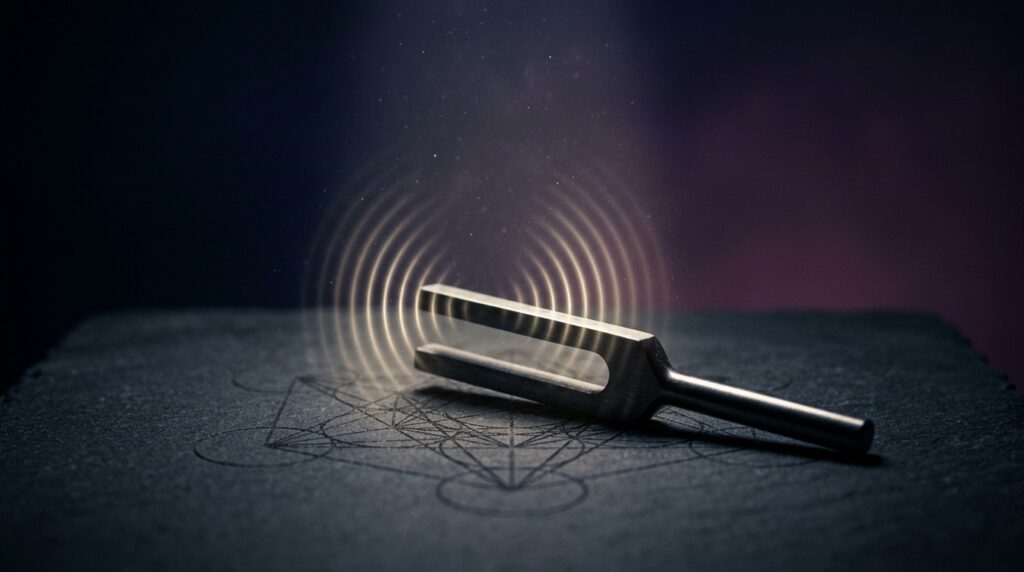
Resonance is a real physical principle. It is why a tuning fork can set a matching string vibrating, and why a loud sound at exactly the right pitch can crack a glass. There is no good evidence that each organ has its own frequency, or that disease can be treated by broadcasting frequencies. What sound can do, for some people, is help them relax.
Types of Frequency Healing
Sound and Frequency Devices
Tuning forks, singing bowls, binaural beats and frequency generators all produce sound you can hear or feel. You will often read that because the body is mostly water, sound moves through you and causes cellular entrainment, with 528 Hz activating repair. There is no reliable evidence for those effects. Calming sound can help some people relax, and research on binaural beats is mixed.
Light Frequency Healing
Light therapies are a mixed group. Sunlight on the skin helps the body make vitamin D, and bright light therapy is used under medical guidance for some sleep and mood problems. Red and near-infrared light therapy is being researched, with mixed results so far. None of this means cells decode light information, and light devices are not a substitute for medical care.
Number Codes and Quantum Healing Codes
In the Frequara practice, number sequences are a focus tool. When you write, speak, visualise or meditate on a code like 528 or 963, you give your attention and intention a simple anchor. The idea that a code carries a frequency signature is part of the Frequara model, a metaphor rather than physics, and no code is a cure. It is the most accessible practice: no equipment, just a few quiet minutes.
Biofield Energy Work
Practitioners of Reiki and other forms of energy healing describe moving energy through their hands and intention to strengthen your biofield. Research does not support an energy field that passes from one person to another, and a Cochrane review found too little good evidence to say whether Reiki helps anxiety or depression. Some people find sessions relaxing; keep up any treatment you receive.
Hertz and Vibration Therapy
Whole-body vibration platforms shake at set frequencies, often somewhere between 15 and 60 Hz. They are studied mainly for muscle strength, balance and bone health, with mixed results, and claims that they boost healing capacity are not established. Check with a doctor before using one.
How to Start a Frequency Healing Practice
Beginner’s Steps
- Choose a practice that appeals to you. Sound, light, number codes, or energy work. Notice what you are drawn to and what you will actually keep doing.
- Start simple. If choosing sound: use a binaural beats app or search YouTube for a 528 Hz or 7.83 Hz track. Listen for 15 to 20 minutes on the days that suit you. If choosing codes: pick one code and work with it for a few weeks, writing it 10 times a day with intention.
- Be consistent, not intense. Like any habit, a practice gets easier with repetition, and how long that takes varies a lot between people. Daily 15-minute sessions are easier to keep up than a weekly two-hour session.
- Notice what changes. Keep a simple note of sleep, energy, mood and how calm you feel. This helps you see whether a practice suits you. If physical symptoms appear or get worse, do not wait for a practice to shift them: see a doctor.
- Layer practices slowly. Once one practice feels settled, add another if you want to. Morning sound, an afternoon code and evening grounding can make a steady, enjoyable routine.
- Work with practitioners if you want to. Choose someone trained who does not promise cures or discourage medical care.
Which Frequencies to Start With
Popular starting frequencies: 528 Hz (often called the love frequency), 7.83 Hz (the Schumann resonance), 432 Hz (an alternative tuning some find pleasant) and 40 Hz (in the gamma range). Treat them as sounds to explore, not as treatments.
If working with number codes, begin with 528 (love and calm), 963 (spiritual awakening), or 111 (alignment). Write, speak, or visualise these daily. Some people notice they feel calmer or more focused after a session; others notice little. Both are normal.
Common Misconceptions
“Frequency healing replaces medical care.” It doesn’t, and it shouldn’t. Think of frequency practices as things to try for calm and wellbeing, alongside the care your doctor recommends. Never stop or delay treatment for a frequency practice.
“It takes years to work.” Some people feel calmer, or notice emotions surfacing, within a single session, while others notice little. These practices are not a treatment, so there is no timeline for physical healing to expect. Judge a practice by whether it helps you feel steadier.
“You need expensive devices.” Helpful for some, but not required. Free recordings, apps and number codes cost nothing. Be wary of devices that promise to treat illness. Intention and consistency matter more than expense.
Going Deeper: The Complete Frequency Healing Framework
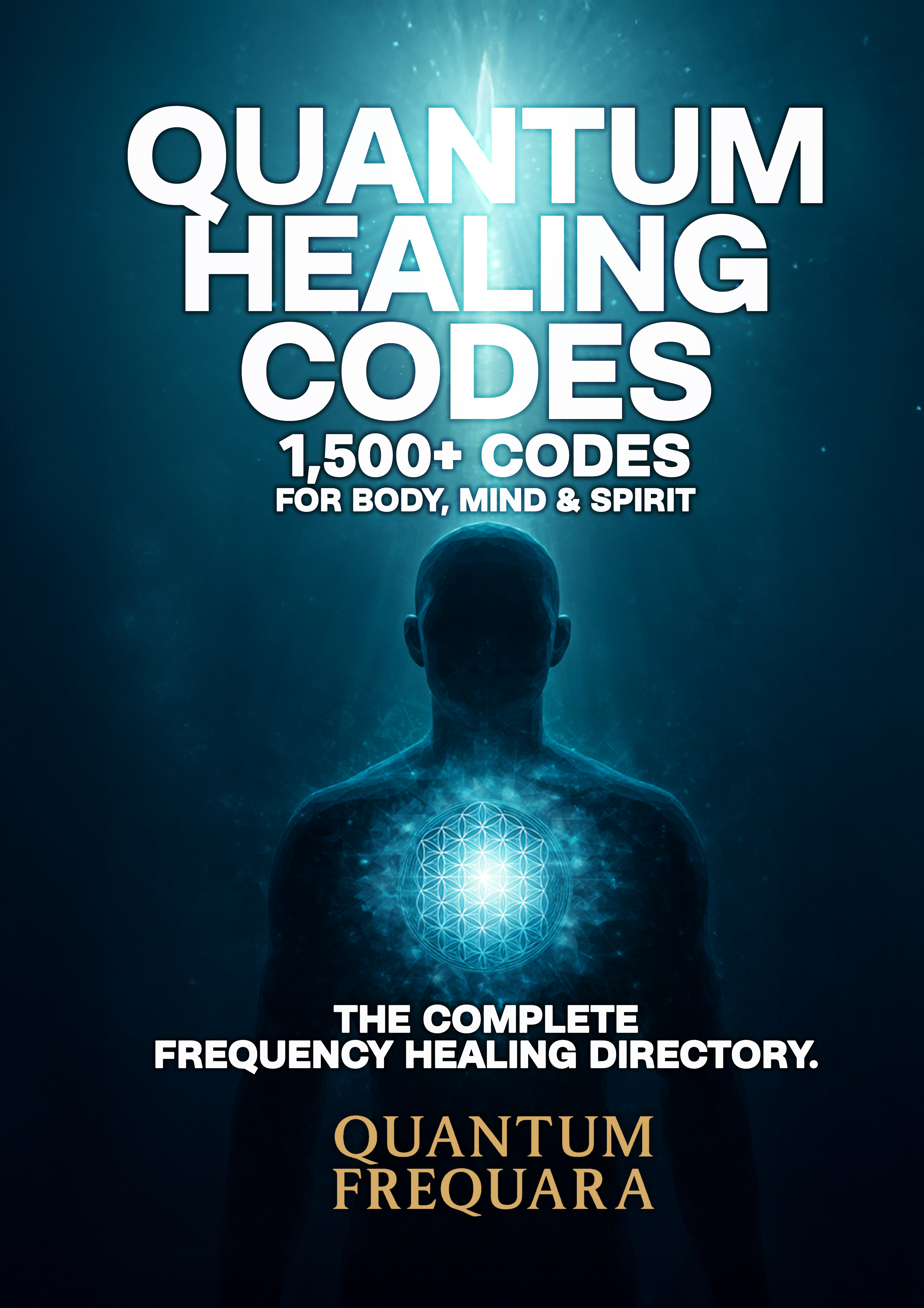
For a fuller look at frequency practices, what the research says, and how to build a personal practice, the Quantum Healing Codes book provides codes, frequency guides and step-by-step practices for focus and intention, from calm and emotional clearing to spiritual awakening. The codes are not cures and not medical advice.
Frequency healing isn’t quantum biology, and it doesn’t need to be. At its best it is a set of simple practices for slowing down, paying attention and choosing a steadier state. Start where you are, with what appeals to you, and notice what genuinely helps.
Continue your work with the codes. Quantum Healing Codes contains 1,500+ intentional number sequences across 40+ categories, including pain, sleep, anxiety and manifestation, paired with the full activation guide and the Frequara Starter Set. The codes are not cures and not medical advice.