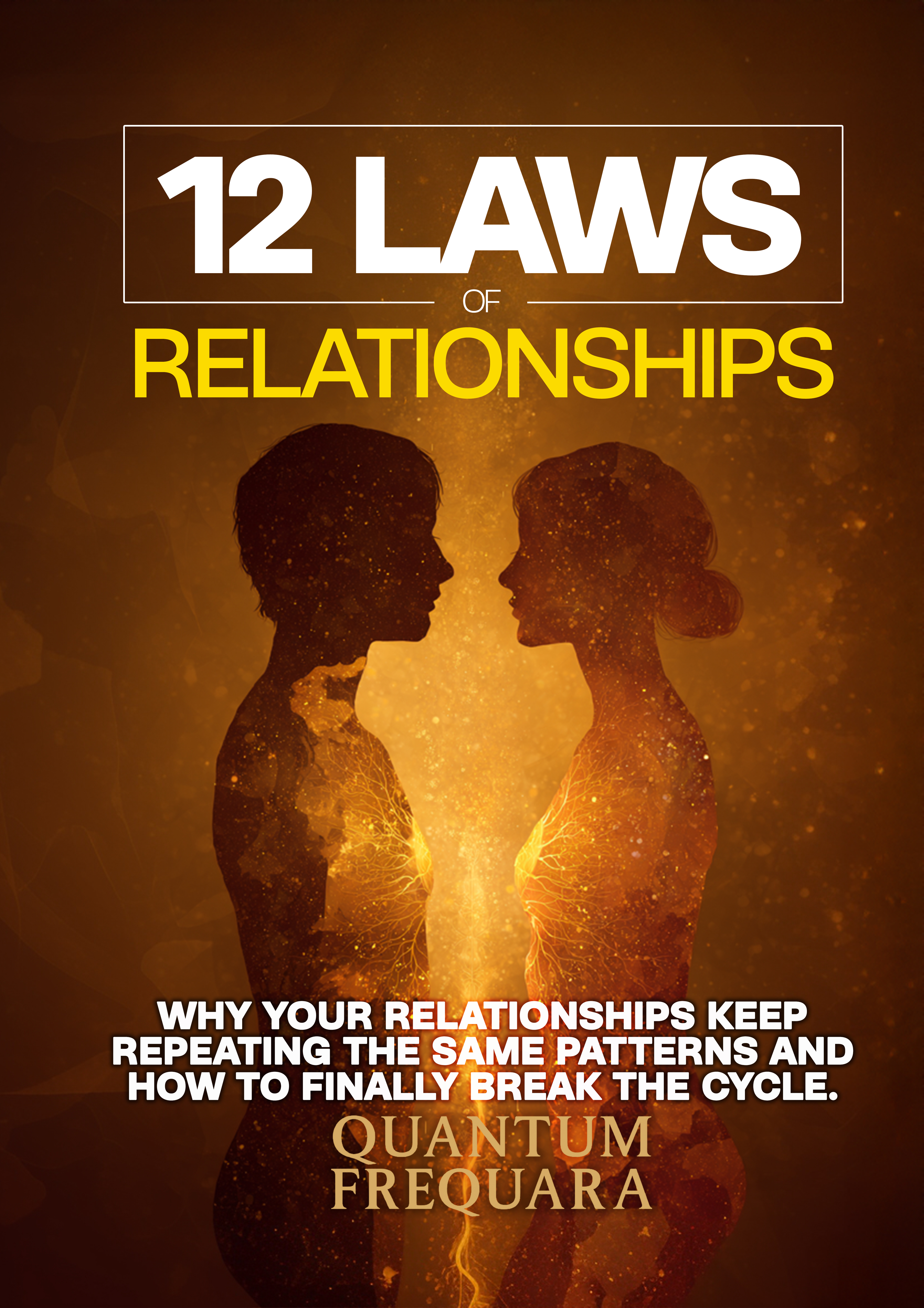
It is 10:47pm. The third date went well, and then the phone went quiet. By midnight the warmth in your chest has been replaced by an older feeling: it is going to go the way it always goes. This book is about what happens in that gap. It describes twelve patterns that run underneath connection, from who feels familiar to you, to how two people find their way back after a fight, and it gives you a practice for each one.
"Conflict is not the enemy of love. Failed repair is."Quantum Frequara
Resonance, the Mirror, Attachment, the Wound, Projection, Bids, Rupture and Repair, Co-Regulation, Individuation, Evolution, Relational Rest and Transmission. They are grouped in three stages: why you choose who you choose, what runs when love is close, and building the relationship you choose.
Attachment research from Bowlby onwards, John Gottman's work on bids and repair, and polyvagal theory (a model, parts of which are debated), explained for a reader who wants to know why the same argument keeps arriving.
Each law closes with the four steps (Recognise, Reset, Realign, Radiate) applied to that pattern: the Resonance Audit, the Mirror Reading, Projection Retrieval, the four movements of repair. Each chapter also lists the signs a pattern is active and the signs a practice is settling in.
Ten minutes, five parts: a one-word check-in, one deliberate bid, a shared breath, one appreciation said out loud, and an intention for the next 24 hours. The book is frank that the first week feels awkward, and it answers the obvious objection: what if my partner will not do this.
Thirty-six questions, three for each law, leading to five profiles: the Pursuer, the Defender, the Builder, the Lone Wolf and the Carrier. A closing section looks at what tends to happen when two profiles meet. A profile is a map for reflection, not a diagnosis.
Five first-response protocols for hard moments: the Shutdown Spiral, the Flooding Response, the Trust Rupture, the Grief Collision and the Identity Crisis. The chapter states its limits plainly. The protocols assume both partners are fundamentally safe, and they are not for relationships where violence is present.
The date went well, and then the phone went quiet. By two in the morning your body had written a whole story about what the silence meant, and at 7:14 the message arrived, warm and ordinary, and the story dissolved. This book starts from a simple question: what happened in between?
You may already know your attachment style well enough to name it at dinner. You may have read the books on love languages and red flags. The pattern has kept running anyway, with different faces.
In the Frequara model, that pattern is your relational frequency: the baseline state your body settles into when another person gets close. It was shaped early, before you had words for it, and it influences who feels familiar, what you read into a silence, and what you do when closeness arrives.
The 12 Laws of Relationships is not dating advice and it is not a rulebook. It says so in its first chapter: it will not teach you how to find the right person, it will not blame you for your history, and it will not promise you a perfect relationship. Two people close to each other will misread each other sometimes. The book's interest is in what happens next, and in the small daily practices that make repair more likely.
Romantic partnership is the main lens. Each law comes with a story (Nadia and her three similar partners, Daniel and the mirror he cannot see, Marcus and Elena on their seventh morning of the protocol), the research behind it, and a practice to try this week.
You keep ending up in the same dynamic with new people, and "bad luck" has stopped being a convincing explanation.
A quiet phone can take over your whole evening. You are tired of your own vigilance, and being told to relax has never helped.
You want closeness, and when it arrives something in you steps back. You would like to understand that reflex instead of obeying it.
You love each other and you keep having one argument in different clothes. You want a way to repair it that both of you can actually do on a weeknight.
You have had enough checklists. You want to understand what your body is responding to when someone feels like "chemistry".
You want the research named and the limits admitted, alongside the reflective side of the work.
Out now on Amazon in paperback and Kindle. 12 laws, 17 chapters, a ten-minute daily practice, a 36-question diagnostic and five repair protocols for the hard nights.
Not medical advice, and not a substitute for therapy or relationship counselling. This book offers practices and perspectives for reflection. If you are not safe in your relationship, seek professional support first.
The Frequara Starter Set: ten codes from the Quantum Healing Codes directory, a 10-minute audio track, and the four steps of the Frequara Correction.
Sent free to your inbox, followed by seven short daily practices. No belief required. No equipment.